Flynne Fisher takes over Burton’s security shifts
The PeripheralFlynne Fisher takes over Burton Fisher’s Milagros Coldiron security shifts when Burton asks her to fly a quadcopter for five hours. The work is advertised to her as a beta game, but its real purpose is perimeter security around a London tower: she is to keep paparazzi away from three floors and, in doing so, enters a remote environment whose unfamiliar city and mechanisms exceed the explanation she has been given. What begins as a well-paid substitute shift becomes Flynne’s practical threshold into another time and another kind of embodiment.
The Assignment and Its Cover Story
Burton presents the shift as a straightforward favor, asking Flynne to sub for him and fly a quadcopter. When she points out that he is on disability and should not be working, he offers little explanation. His account is deliberately thin: it is a game, he says, though the work is for a security firm. The contradiction is sharpened by the money. Ten thousand dollars will go into Flynne’s pocket, and Burton says he has been doing the job for two weeks, with Sundays off.
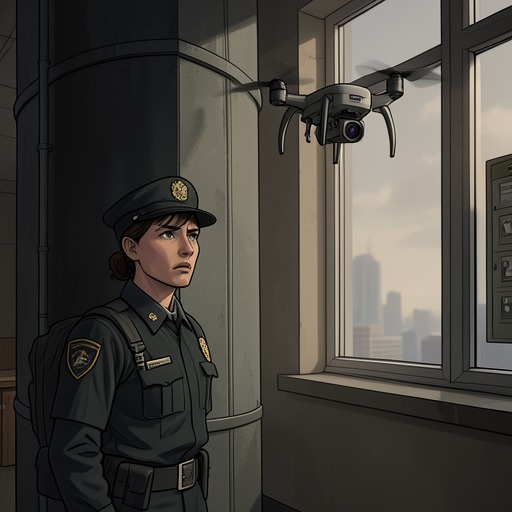
The assignment’s actual task sounds almost mundane. Flynne is to work a perimeter around the fifty-fifth, fifty-sixth, and fifty-seventh floors of a tower, watching for paparazzi and edging them back. She is not supposed to shoot anyone or confront a conventional threat. The instructions make security sound like a low-stakes game of boundary keeping, but they do not prepare her for the unfamiliar city, the remote viewpoint, or the urgency of the voices she will hear once connected.
First Login: A Viewpoint Without Control
At home, Flynne bends her phone to the angle she prefers for gaming, enters HaptRec, and presses GO. The display flashes silver, and she finds herself rising out of what Burton has described as a launch bay on the roof of a van. She has no control yet. Around her are faint, urgent whispers, like dispatchers speaking from a source she cannot see or understand.
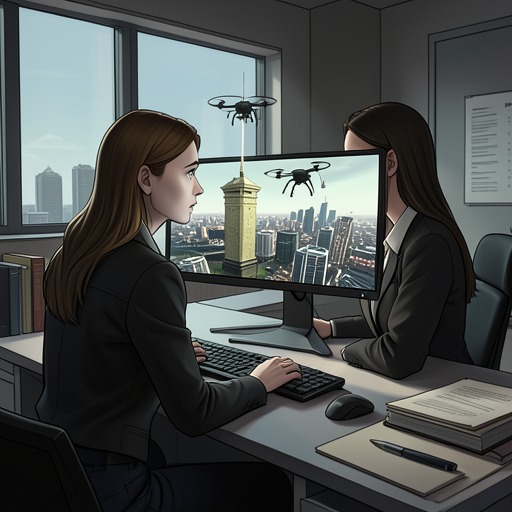
The view itself confirms that the assignment is not an ordinary game. Rainy light lies over a dark city; a river appears cold and metallic, and distant towers rise above the streets. Looking down, Flynne sees the van shrink below her; looking up, she sees the tower stretch away like a cliff. This sudden change in scale makes the remote perspective vivid before she has the means to direct it. She has entered the job, but not yet mastered the interface.
Learning the Perimeter
On a later shift, Flynne plans what to inspect as she goes up. The launch vehicle now looks less like a van than an armored car, with a square, dark bay from which the copter emerges. She tries to follow the aircraft upward, but cannot make it rise more quickly and loses sight of it. The experience gives her a working problem rather than a complete explanation: she can observe, test, and infer, but the system retains control over parts of her movement.
At the fifty-sixth floor she finds a balcony folded down behind frosted glass. She guesses that she has missed the party and waits by the window, hoping to learn something about what happened there. No bugs appear, and the mechanism that had carried her upward like an elevator is gone. After waiting, she checks the perimeter again and notices a grate steaming on the far side. The search produces no clear answer, but it changes the shift from a simple patrol into an investigation conducted through limited access and incomplete sight.
Flynne’s local circumstances intrude on this distant work. While checking Badger, she sees that Burton is off the map and determines that he is at the Hefty Mart parking lot in Davisville, where she guesses Homeland Security trucks may be holding his phone. She understands that Homes can see she has made the check and worries instead about whether anyone will notice that her phone is unusual. The remote assignment therefore sits alongside surveillance and uncertainty at home; the two environments are connected by the same device, even as Flynne has only partial knowledge of what each connection exposes.
A Tool That Means Different Things
The language around Flynne’s work repeatedly understates what it enables. Burton calls it a game, and Flynne initially thinks of the phone as a game controller; later she objects when someone describes the interface in those terms. The correction is that it is a telepresent interface, one that can work without hands. In another exchange, a piece of hardware is discussed as something to be arranged and paid for, though the speaker says they would not know how to explain what it does. Across these descriptions, the technology appears not as one stable object with one shared meaning, but as equipment various people can use without fully describing or understanding it.
That uncertainty becomes concrete when Flynne accesses an anthropomorphic drone. She wakes to hands that are not her own and sees a face unlike hers reflected in a steel canister. Ash explains that Flynne is receiving input from a telepresence avatar, and tells her not to consciously control it while it is being recalibrated. Macon’s device is imperfect, but it works. The shift from the aerial copter to a human-shaped remote body makes the stakes of the earlier interface clearer: remote access can extend beyond observation and become an embodied presence, while leaving the user to catch up with what the system has already made possible.
Consequences and Significance
Flynne’s substitute work does not end with the discovery of the tower’s perimeter. She is later told she is there to help Burton, and, by implication, to help the person addressing her too, although Jackman had not mentioned her. The assignment has drawn her into a chain of responsibilities that reaches beyond the narrow job description Burton supplied. Its five-hour shifts begin as paid security work; their consequences include her growing involvement with people and equipment whose purposes are not fully disclosed to her.
The event’s importance lies in the gap between the familiar terms and the strange labor they conceal. A phone, a game login, a quadcopter, and a promised wage form the ordinary surface of the job. Underneath is a remote viewpoint over another London, a tower whose upper floors hold an unexplained gathering, and technology that can place Flynne in an unfamiliar body. The work makes the future accessible through an everyday task, but never wholly legible: Flynne learns by looking, waiting, and testing the boundaries of a system that can act before she understands it.